

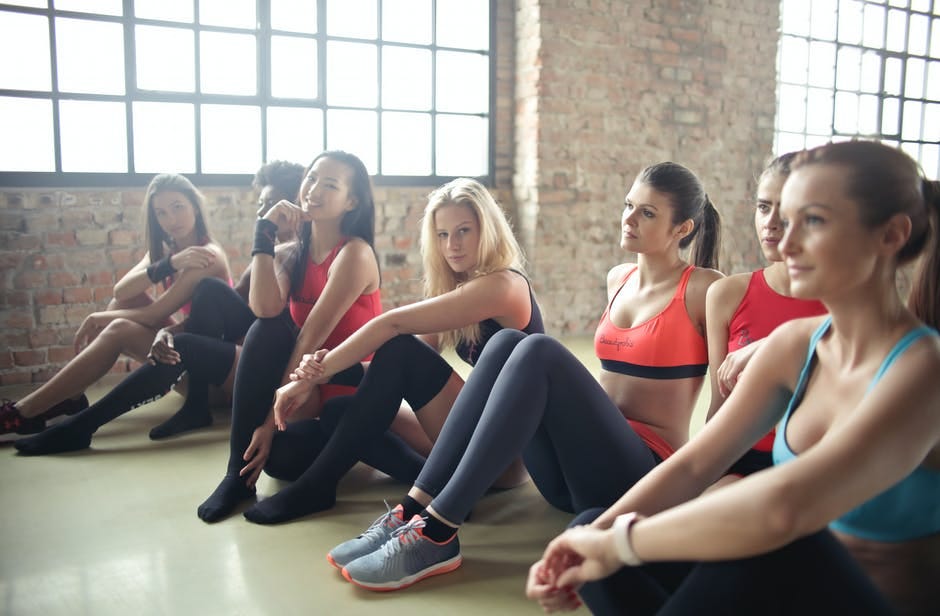
Warm Up
Imagine you’ve just moved somewhere new, away from your normal fitness routine, and you decide to try something you’ve never done before: a group exercise class. You’re not looking to join a fitness community — you just like having structure for your workouts. You walk into the gym with your earbuds in, head down, checking your phone so you don’t have to stand alone awkwardly outside the studio. You slip in quietly, grab your equipment, and claim a spot on the floor.
The class starts. You’re still not interacting with anyone. You’re just there to move your body and leave. The first exercise is a bodyweight arm routine — no weights. Skeptical, you lift your arms into a T and start tiny pulses.
Then, a minute in, it happens. Your arms start to shake. You glance at yourself in the mirror — and notice other people glancing up too. Someone widens their eyes, just as surprised as you all realize you’re not even halfway done. Someone lets out a quiet laugh. When the song finally ends, everyone drops their arms at the same time and exhales in relief.
Suddenly, people start talking.
“Okay, that was harder than I thought.”
“My arms are dead.”
“Why did I think no weights meant easy?”
By the time you leave, you’re chatting with the people next to you. Nothing deep — but enough to feel like you weren’t just alone in a room full of strangers anymore.
This is something I see constantly in the barre fitness classes I teach. I’m known (lovingly, I think) for my bodyweight arm routines — the kind people assume will be easy until about thirty seconds in. I can always spot the moment when surprise turns into shared struggle, and then into shared smiles in the mirror once everyone realizes they’re in it together.
Nothing about that moment forces intimacy. No one is asked to open up or explain themselves. But when the class ends, people linger. They joke. They introduce themselves. The ice breaks — not because they talked it out, but because they felt it out together.
What actually leads us to empathize with others? Empathy (to a healthy extent) is often cited as a crucial ingredient for well-being and social closeness, but the motivation for empathizing across divides is often undermined by intergroup anxiety and social pressure (Pradella, 2024; Small et al., 2025). If we are not motivated to empathize, where do we begin?
My argument: group exercise.
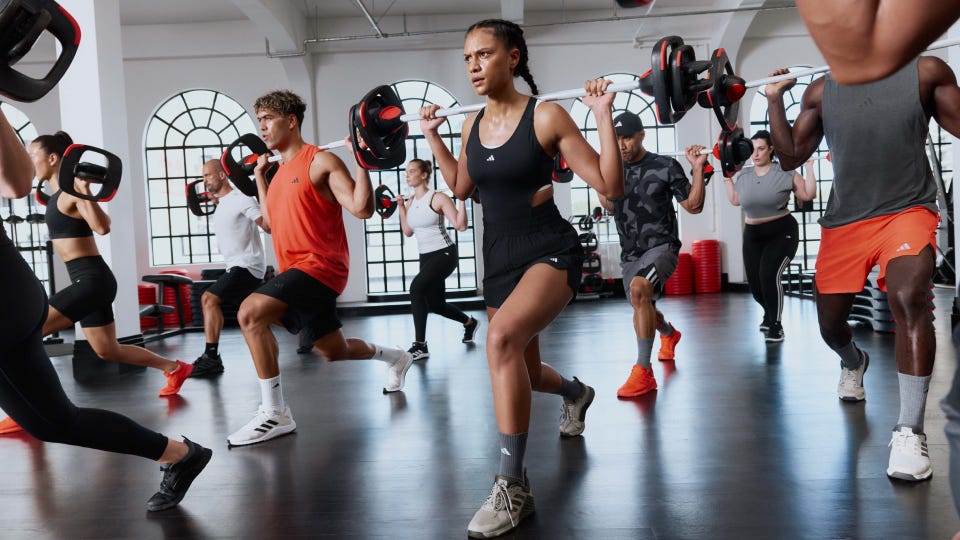
Empathy Equipment
Researchers often describe cognitive processing using the distinction between top-down and bottom-up processes. Top-down processing is deliberate and reflective — like consciously trying to understand someone else’s perspective or regulate your response in a social situation (Gregory, 1997). Bottom-up processing is fast and automatic — the kind that kicks in when you mirror someone’s movements, feel the emotional tone of a room, or fall into rhythm with others without thinking about it (Gibson, 2002). Empathy draws on both systems (Decety & Meyer, 2008; Jankowiak-Siuda et al., 2011). When people move in sync, that shared rhythm primarily engages bottom-up processing, creating automatic alignment before conscious interpretation begins. This doesn’t generate empathy on its own, but it can reduce social friction and make the more effortful, top-down aspects of empathy easier to access. In that sense, synchronized movement acts as a facilitator: it prepares the conditions under which empathy is more likely to be cultivated.
Shared activities like music and synchronized movement seem to tap right into this bottom-up side. For example, one study using a simple finger-tapping task found that interpersonal movement synchrony was associated with increased cognitive empathy, or perspective-taking, toward a social partner (Koehne et al., 2016). And what appears in minimal lab tasks becomes much more pronounced in real-world settings where people move, create, and coordinate together over time. Research on long-term musical group interaction shows that certain interactional features — things like motor resonance, entrainment, imitation, and the development of shared intentionality — are central to the way groups of people coordinate and create together (Rabinowitch et al., 2013). The kinds of coordination that happen in group music (and, by extension, group exercise) are bottom-up mechanisms at work. Getting on the same beat, mirroring each other’s actions, and navigating a shared physical task all shape the interactional environment in ways that lower the bar for top-down perspective-taking.
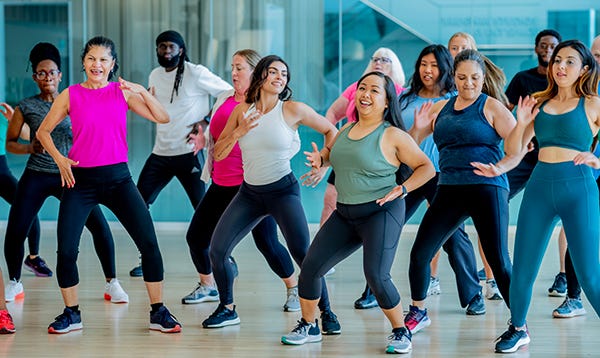
Empathy Gains
Different kinds of movement-based interventions provide a useful window into these full-body (and mind!) workouts. Research on dance movement therapy, where individuals or groups engage in rhythmic movement together as part of a structured intervention, finds benefits not just for mood and well-being but also for social functioning (Behrends et al., 2012; Koch et al., 2019). Across many group movement interventions, participants tend to report lower levels of depression and anxiety, reduced social isolation and loneliness, and increased feelings of social bonding (Fancourt et al., 2016 Sebastião & Mirda, 2021; Stupacher et al., 2022). These outcomes are often accompanied by greater social connectedness and improved emotional engagement with others following sessions that involve coordinated, shared movement.
Evidence for these effects also comes from intervention and experimental studies that directly examine how group movement shapes social behavior. In one school-based intervention, junior high school students who participated in a 12-week group basketball program showed significant increases in empathy, interpersonal relationships, and prosocial behavior compared to peers in standard physical education classes (Tang et al., 2025). Importantly, empathy and improved social relationships statistically mediated the link between exercise and prosocial behavior, suggesting that movement alone was not sufficient—rather, it was the social and relational aspects of group activity that drove these gains. Complementary laboratory research reaches similar conclusions. In a study of minimally defined groups, participants who engaged in synchronized movement reported stronger social bonds than those who moved asynchronously (Tunçgenç & Cohen, 2016). This effect extended beyond in-group favoritism: synchronous movement increased feelings of closeness toward out-group members as well, as measured by both self-report and behavioral indicators of physical proximity. Taken together, this body of work suggests that group exercise environments can serve as especially fertile ground for cultivating empathy and bridging divides.
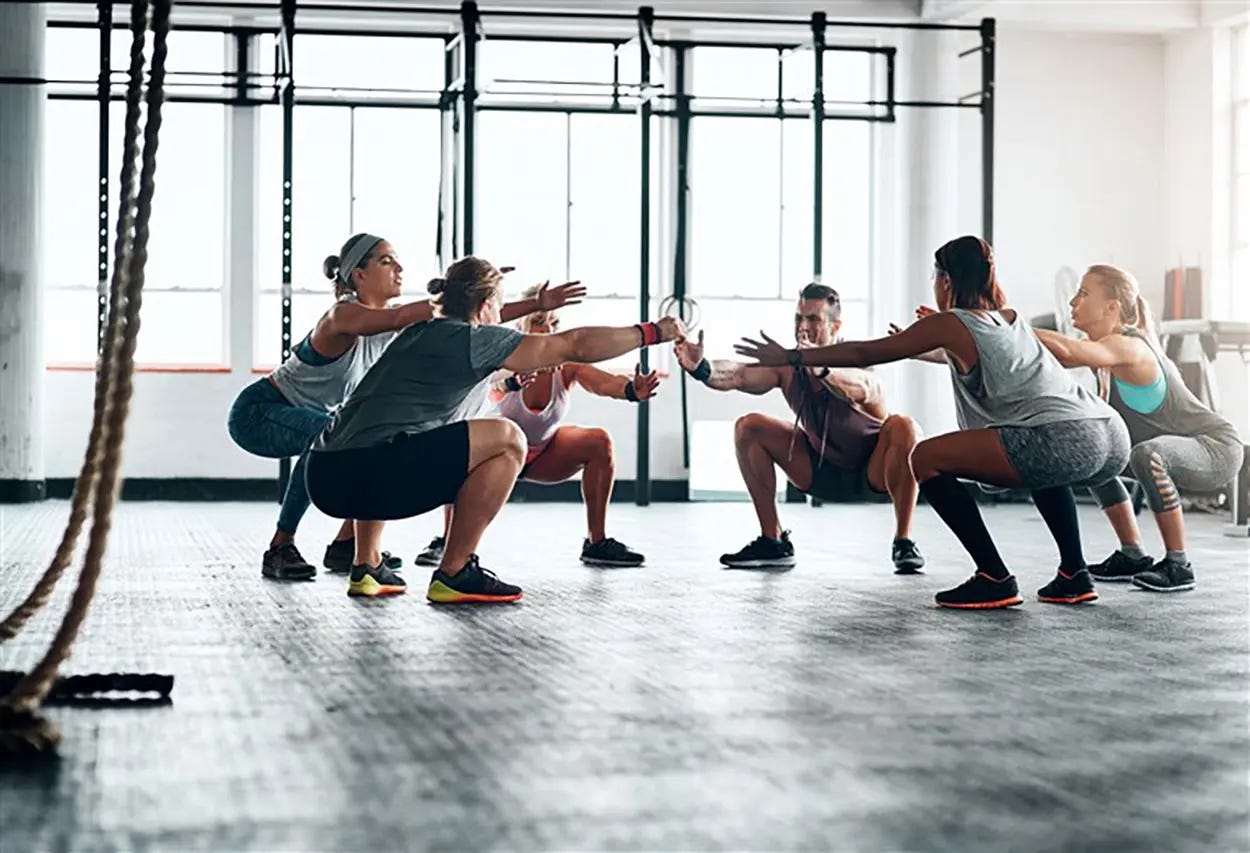
Cool Down
By the time you leave the group exercise studio, your arms are fatigued in that deep, satisfying way. You wave to the instructor on your way out. You make a mental note of their name. The earbuds go back in, but now it feels different than when you walked in. This is why group exercise works. Not because it magically creates empathy or instant unity, but because it reliably creates shared moments that make people feel less alone. You don’t have to agree, explain yourself, or even talk much at all. You just have to show up and move.
Over time, those small, shared moments add up. They make conversation easier. They make relationships more likely. They make empathy less effortful when it’s needed later.
You didn’t come to class to make friends or build empathy. You came to work out. And somehow, by lifting your arms alongside strangers and struggling through the same routines, you walk out with a little more connection than you expected.
Group exercise: Come for the burn, stay for the bond!