
One Tailgate at a Time
What sports fandom can teach us about tribalism, politics, and disagreeing without forgetting we’re on the same team.
My childhood crush was the 2010-2014 Pittsburgh Steelers kicker Shaun Suisham (that link takes you to his stats…you more likely want to see this). While he may have been a compelling reason for me to start watching games (I was 9-13 years old), I stayed for more than the lonesome kicker. Somewhere with my Antonio Brown jersey and Terrible Towel, I started to…bleed black and gold.
…Bleed?
Sports fans say things like this constantly. We “ride or die” for our teams. We feel weirdly territorial when rival fans show up in our section. We wear certain colors like social uniforms and participate in group-specific rituals. The language is dramatic, tribal, and deeply identity-driven. And yet, despite all of that intensity, sports fandoms rarely create the kind of deep social division we see in politics. That’s where things start to feel different from other kinds of group identities.
You can see this divide with one really interesting question: how unhappy would you be if your son or daughter married someone who…?
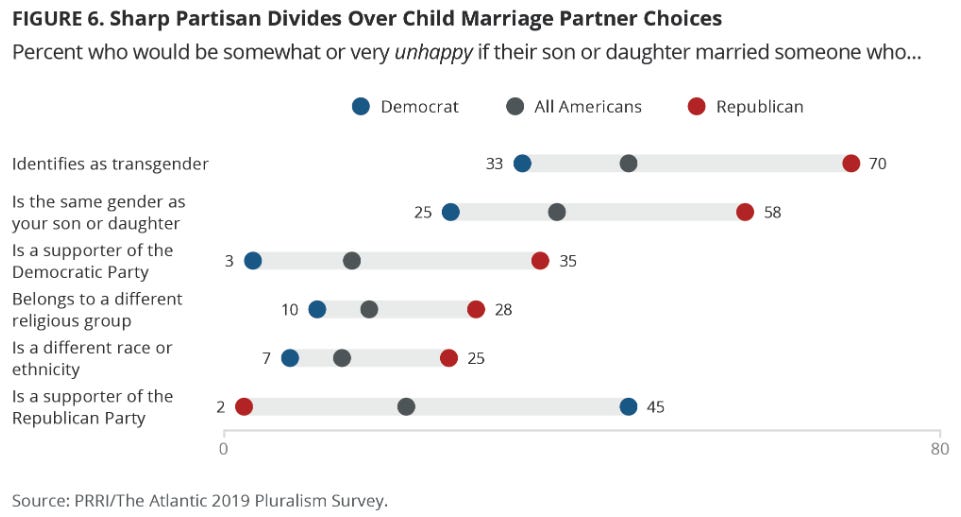
In a 2019 Public Religion Research Institute survey, Americans reported relatively low discomfort with their child marrying someone of a different race or religion—but much stronger reactions to cross-party marriage. In fact, 45% of Democrats said they would be unhappy if their child married a Republican, while 35% of Republicans said the same about a Democrat. This poll is from seven years ago, and affective polarization has only intensified since then.
At first glance, this might seem like a story about political disagreement. Increasingly, however, researchers argue it is more a story about emotional and moral division between groups.
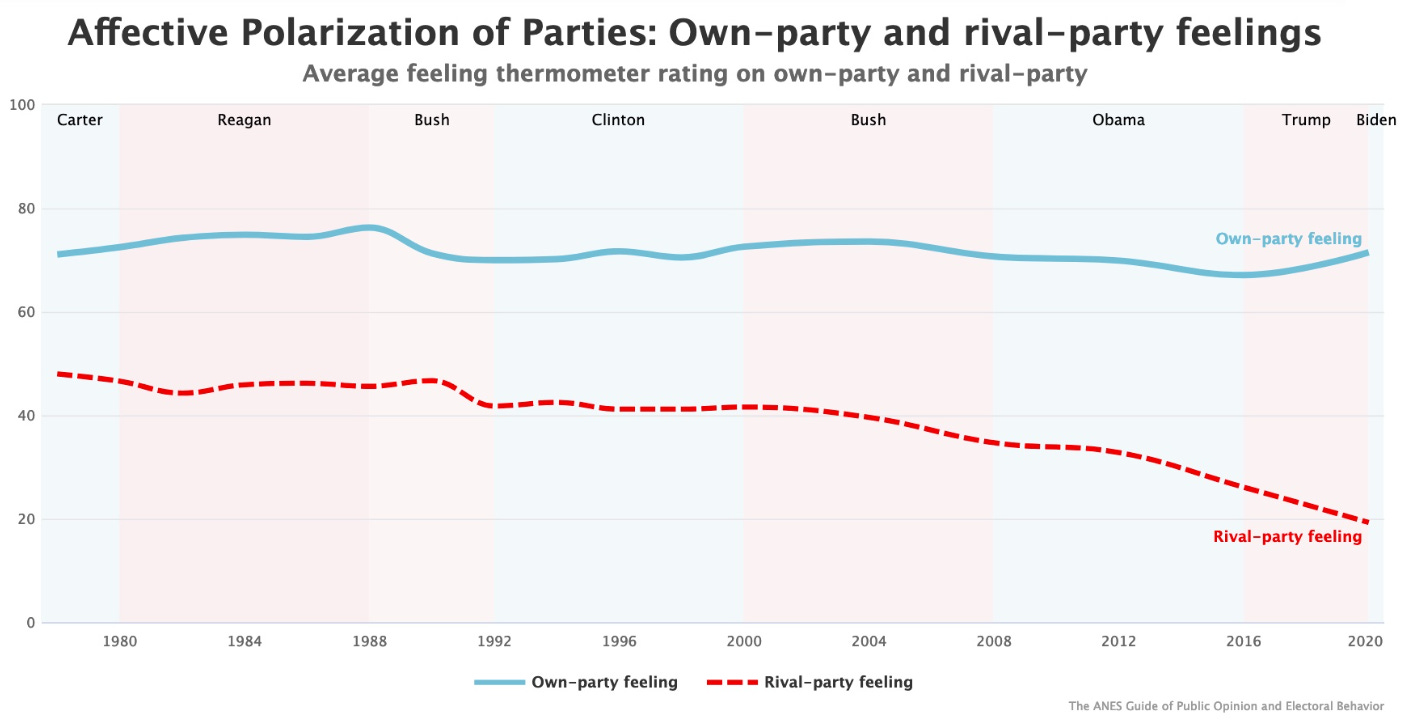
It turns out that Americans are not dramatically divided on policy issues, but instead deeply divided in their emotional reactions toward one another (Brady et al., 2023; Lees & Cikara, 2021; Mason, 2018). Political scientists refer to this as affective polarization: a form of polarization driven less by policy disagreement and more by distrust, aversion, moralization, and social distance between groups.
In other words, the problem is not simply, “We disagree.” It is, “People like them are bad and they think that about us too.”
Perhaps most damaging, however, is the growing perception that the “other side” no longer truly cares about the country—or about people like “us.” Psychologists call these distorted assumptions meta-perceptions: what we think other people think about us. And increasingly, many Americans seem convinced that the opposing political side sees them not just as wrong, but as immoral, unintelligent, or dangerous (Landry et al., 2021; Moore-Berg et al., 2020; Petsko & Kteily, 2024). Research on affective polarization suggests Americans increasingly perceive political opponents not simply as wrong, but as hateful, brainwashed, ignorant, and even racist (Yudkin et al., 2019).
And yet, intriguingly, not all forms of tribalism seem to produce this same outcome.
I’ll admit, I’ll miss having John Harbaugh as an easy public enemy #1 during our games with the Baltimore Ravens. Yes, I said “our games” and yes, I said “enemy.” I grew up with this language and am socially encouraged to have a negative reaction to a purple jersey in a sea of black and gold. By all accounts, this probably should be terrible training for navigating disagreement.
And yet, sports fandoms may actually do the opposite.
Recent research from More in Common suggests sports fandoms may actually relate to healthier forms of political engagement. In one national survey, highly invested sports fans were more likely (68%) than non-fans (46%) to say they were interested in talking about politics with people who disagreed with them politically. They were also more likely to say they wanted both political parties to work together to solve national problems (87% compared to 77%) and more willing to collaborate across political lines toward shared community goals (82% compared to 65%). Even respect for political opponents was slightly higher among sports fans than non-fans (89% compared to 81%).
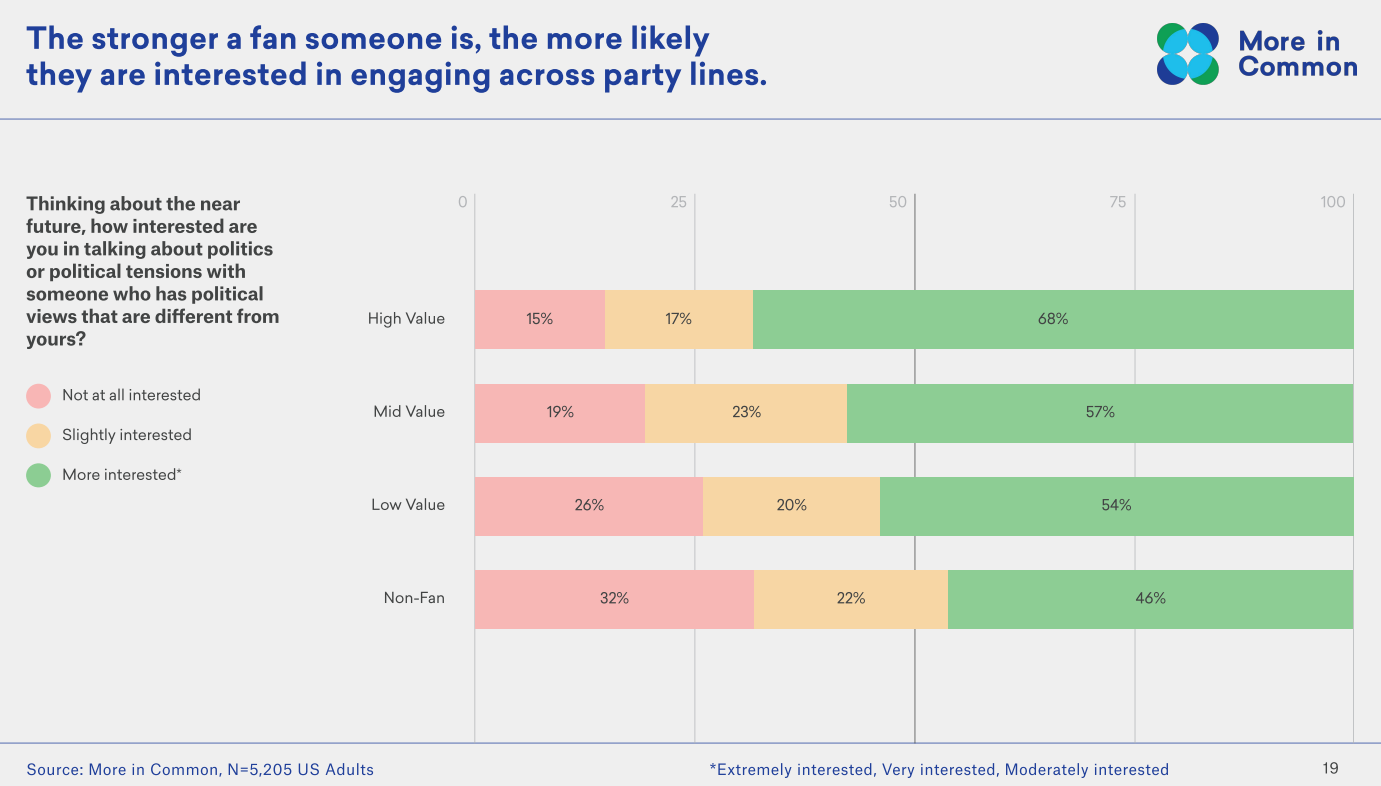
In other words, sports fandoms do not seem to eliminate tribalism. Instead, they seem to teach people how to live with it.
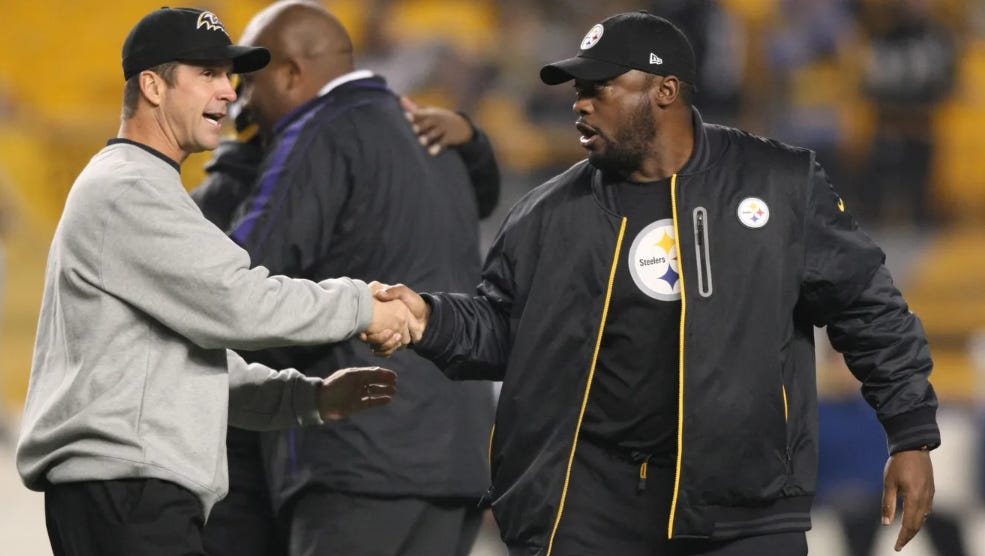
What may make sports rivalries psychologically different from political polarization is that sports fans rarely lose sight of the larger ingroup surrounding the rivalry itself. Steelers fans and Ravens fans may despise each other for four quarters, but both sides still love the game. They share the same rituals, emotional investment, social norms, and overarching structure of this larger ingroup. The rivalry exists within a larger shared identity rather than replacing it.
Maybe the problem, then, is not the tribalistic groups themselves. Humans are probably always going to form groups, loyalties, rivalries, and emotional attachments. We want teams to root for. We want identities that make us feel connected to something larger than ourselves. The real danger may come when those rivalries stop existing within a shared identity and start replacing it entirely.
Democracy depends on people viewing political opponents as fellow participants within the same collective system, even when disagreements are intense. Once opponents stop feeling like fellow Americans with different priorities and start feeling like enemies fundamentally opposed to the nation’s wellbeing, the larger ingroup begins to collapse. In fact, affective polarization appears increasingly linked to declining trust in democratic norms and institutions, further eroding the sense of a larger shared identity Americans are supposed to hold in common (Cox et al., 2025; Kingzette et al., 2021).
Sports fandoms—which appear tribal on the surface—may actually provide a training ground for polarization and reinforce this larger-ingroup thinking. The same report from More in Common found that stronger sports fandoms were associated both with a stronger commitment to democracy (73% to 53%) and stronger agreement that Americans “have more in common than what divides us” (63% compared to 56%).
It seems like one of the best reminders of how to fiercely disagree without completely abandoning a common ingroup may not come from politics at all. For me, it’s a lifetime of Mike Tomlin and John Harbaugh’s teams showing me what intense rivalry should look like, and that not all Baltimore Ravens fans are bad.
Just some.
Now here’s what I want to know: If you’re a sports fan, how unhappy would you be if your child married someone who is a fan of your rival sports team? Answer our poll!